As you have seen in the previous section, negative thoughts can play an adverse role in one’s happiness. A primary goal of Happy Thinking is to help you to recognise and overcome negative thoughts. To help with recognition, I will briefly describe common negative thoughts on this page. As you read through the negative thoughts in the list below, see if you can recognise some of them in yourself and others around you. Of course, not all of them will apply to you, and you may have ones unique to you that aren’t mentioned here.
Magnifying the negative
Here, your thoughts excessively focus on negative events in your life while ignoring positive ones. For example, imagine you are told you will get a pay rise, but that same day you also lose your expensive phone. When you magnify the negative, you fixate on the loss of your phone while overlooking the positive event of a salary increase.
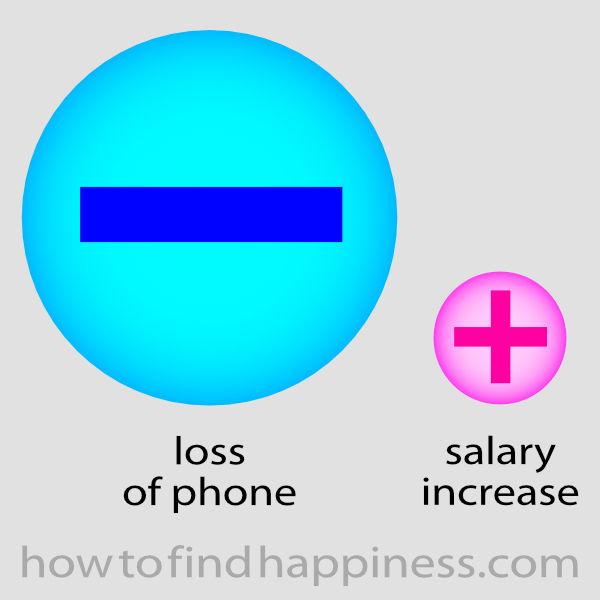
This type of negative thinking, where you focus on the negative while minimising the positive, can make you feel things are worse than they are because you overlook positive events that could counteract the negativity. (e.g. “Yes, it’s upsetting that I lost my expensive mobile phone, but on the brighter side, I got a nice salary raise at work”.)
“All or Nothing” thoughts
With this way of thinking, you see everything as either being extremely positive or extremely negative, rather than in a more realistic way, between the two extremes.
For example, imagine you have a good, loyal friend of many years who once forgets to wish you a happy birthday. With all-or-nothing thinking, you will think this friend is 100 per cent bad for forgetting the birthday. In reality, it was only one “bad” thing among many more “good” things the friend has done over the years. All-or-nothing thinking can lead you to judge people unfairly.
Imagining only the worst outcomes (catastrophic thoughts)
In your daily life, your mind constantly imagines the future (e.g., hours, days, or years ahead). Imagining what may happen in the future is vital for your survival. It helps you make good decisions in the present that will lead to a better future.
Unfortunately, this imagination system can sometimes go wrong and become negative. That is, you imagine only the worst possible future outcomes, i.e., that everything in the future will be a “disaster” or “catastrophe.” You do not consider future scenarios that might be less bad. These “worst outcome” thoughts are what psychologists call “catastrophic thoughts”.
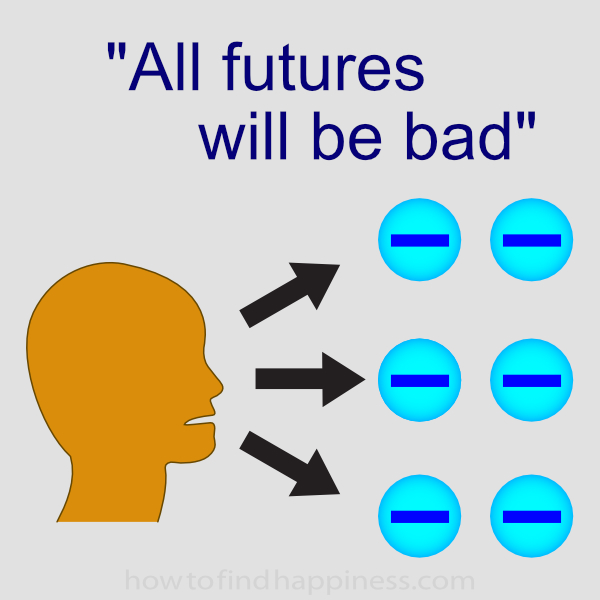
For example, imagine that your boss sends a message, with no further explanation, that he wants you to meet him in the office the next day. You may then have catastrophic thoughts that the boss wants the meeting to say that you are fired from the company. In reality, the boss may only want to discuss a project.
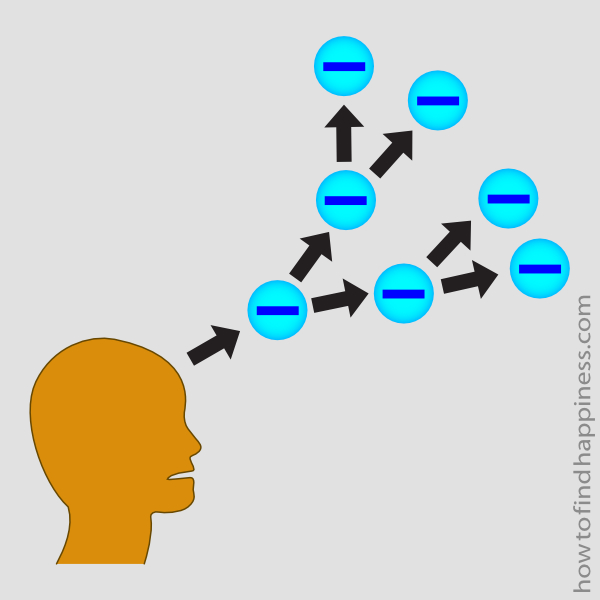
With catastrophic thinking, you may add further layers of imaginary “worst outcome” scenarios. For example, continuing with the previous scenario of imagining that you will lose your job, you might further add more catastrophic thoughts such as, “With the loss of my job, I would become extremely depressed, and because of this, my partner may leave me. I will not be able to afford the rent and end up being homeless, sleeping on the street”.
All this causes unnecessary stress, since everything is based on imagination rather than facts.
Over generalisation
Over-generalisation is when you experience a negative event and assume the same thing will happen again and again.
For example, if you fail an exam, you assume that you will fail all future exams.
Mind reading
Here, you assume you know what the other person is thinking, when in reality it’s impossible to know for certain what that person is actually thinking. Typically, you wrongly assume that the other person is thinking something negative about you.
For example, a friend sees you and does not smile. You assume the friend is angry when in reality, the friend just has a severe headache.
Personalisation
You wrongly assume you are to blame for something when, in reality, you had nothing to do with it.
For example, a doctor gives the correct diabetic medication to a patient, yet the patient has high blood sugar (because of poor dietary habits). Even though it has nothing to do with the doctor’s competence, she feels it’s her fault.
Negative comparisons
Thinking that others are better than you, when in fact they may not be.
Not accepting the positive
When you receive praise, you look for reasons it is undeserved.
For example, when someone says your presentation was excellent, you dismiss it by thinking, “they are saying it only to make me feel good”.
I hope the list above has given you an idea of what these common negative thoughts are about. As you go about your day, try to recognise these thoughts in yourself and in others around you. Later on this website, we will discuss some other common ones not mentioned here.