As you know, an important aspect of Happy Thinking is finding happiness by challenging and overcoming negative thoughts. However, before we move on, let us understand how negative thoughts can affect happiness.
In one’s day-to-day life, various events can occur, including issues with loved ones, at work, with finances, and with health, and so on. One’s mind analyses these events in a certain way, generating thoughts. Unfortunately, these thoughts may not reflect the reality of the events and may instead paint an exaggeratedly negative picture. These negative thoughts then make one feel worse than the situation actually is. That is, the negative thoughts do not match reality. To better understand this, I will explain common negative thought patterns below.
I have simplified them to keep them brief, whereas in real life, a given individual’s negative thoughts can be more complex and unique to that person. While the types of negative thoughts are mentioned individually, in reality, there can be some overlap between them. Also, these are only common examples; there are negative thoughts not on this list.
As you read through these negative thoughts, see if you can recognise them in your own thinking and those around you.
Magnifying the negative
This negative thought is when one focuses on negative events in one’s life while ignoring positive ones. For example, imagine that one day a person gets a promotion at work, but unfortunately, they also lose their expensive phone that same day. When magnifying the negative, the person will fixate on losing their mobile phone while overlooking the positive event of getting a promotion at work.
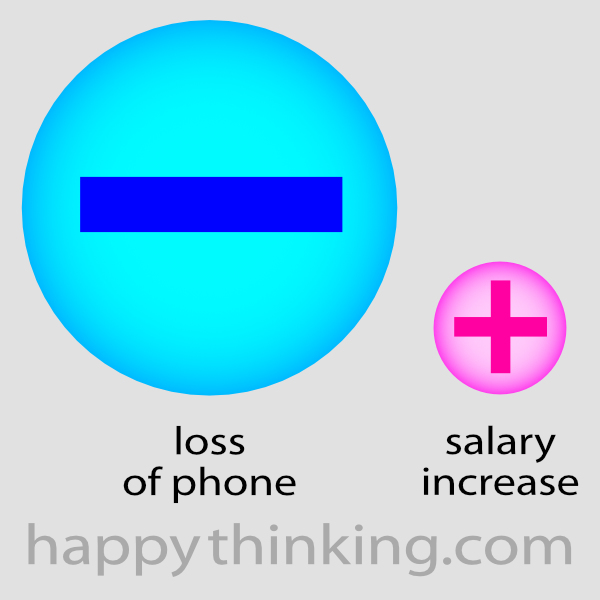
This type of negative thought, where one focuses on the negative while minimising the positive, can make one feel that things are worse than they actually are, as positive events that could counteract the negativity are overlooked. A more blanched way of thinking could have been, “Yes, it’s upsetting that I lost my expensive mobile phone, but on the brighter side, I got a nice promotion at work”.
“All or Nothing” thoughts
With this way of thinking, one sees everything as either being extremely positive or extremely negative, rather than in a more realistic way, between the two extremes.
For example, imagine that one has a good, loyal friend of many years, who once forgets to wish one on one’s birthday. With all-or-nothing thinking, the person will think this friend is 100 per cent bad for forgetting the birthday. Whereas in reality, it was only one “bad” thing among the many more “good” things the friend has done over the years. A more balanced way of thinking could be, “Yes, it was bad for my friend to forget my birthday, but my friend overall is really good”. All-or-nothing thinking can lead one to judge people unfairly.
Imagining only the worst outcomes (catastrophic thoughts)
Let me now explain a common negative thought, which psychologists call “catastrophic thought.”
In daily life, one’s mind constantly imagines the future. When I refer to “future”, I do not only mean years ahead. It could well be much shorter in the future, such as hours and days. Imagining what may happen in the future is vital for survival. It helps individuals make informed decisions in the present that will lead to a better future.
Unfortunately, this imagination system can sometimes go wrong and become negative. Some people imagine only the worst possible outcomes, i.e., that everything in the future will be a “disaster” or “catastrophe.” They do not think of any future scenarios that might be less bad.
For example, imagine that a person’s boss sends him a message with no further explanation that he wants to meet him in the office the next day. This person then has the negative thought that the boss arranged the meeting to announce that they will lose their job. This thought makes the person anxious and keeps him awake all night. However, when the person actually met the boss the next day, it turned out that he just wanted to discuss an upcoming project.
Such thoughts are what psychologists call “catastrophic thoughts”. Catastrophic thoughts can cause one to have unnecessary severe distress as the thoughts are based on imagination rather than facts. A more balanced approach would have been to consider different outcomes, both positive and negative, and wait to see what happens, rather than imagining and worrying only about the worst.
Overgeneralisation
Where one negative event occurs, the person assumes the same negative thing will happen repeatedly. For example, if one fails an exam, one assumes that one will fail all future exams.
Mind reading
Here, a person wrongly imagines that another person thinks something negative about them. For example, imagine one sees a friend across the corridor, but that friend does not smile. One then assumes the friend is angry and ignoring them, when in reality the friend just has a severe headache.
Personalisation
One assumes one is to blame for something that went wrong when, in reality, one had nothing to do with it. For example, a colleague is sad and upset. One then feels responsible for that person’s sadness, when in reality one has nothing to do with it. For example, that person may have recently lost a loved one.
Negative comparisons
Thinking that others are better than you, when in fact they may not be.
Not accepting the positive.
When someone praises oneself, one tries to find reasons why the praise is undeserved. For example, someone says one’s presentation was excellent, yet one dismisses it, thinking that “they are saying it only to make me feel good”.
Untrue negative beliefs
Having untrue negative beliefs about themselves, others, or the world. Examples of such are:
“I am useless”
“Most people can’t be trusted.”
“The world is mostly dangerous”
“I should” or ” I must” thoughts
Here, one makes very rigid rules and expectations for oneself. Then, when one fails these rules, one blames oneself for the failure, even though the rules were not realistic in the first place. Here are some examples:
“I should not make any mistakes”
“I should never feel anxious”
Impulsive pleasure thoughts
These are thoughts that lead one to do something that gives immediate pleasure, without considering longer-term harmful effects. For example, without thinking, eating biscuits to relieve stress, even though that can have negative consequences over time.
Anger thoughts
Feeling over-angry about various things
Rumination
This is when one’s mind repetitively replays a negative event that has happened, in an attempt to “settle” it. In reality, the event has already happened, and reliving it won’t resolve any issues; it only causes distress.
For example, imagine that at work, someone was rude to a person once. Then, over the next few days, the person keeps reliving that event in their mind, with thoughts such as answering back, complaining, etc. Whereas in reality, the event has already happened, and reliving it, even with different responses in one’s mind, does not solve the issue.
These are a sample of common negative thoughts. You may be able to think of other negative thoughts that may be unique to you. As you go about your day, try to recognise such thoughts in yourself and in others around you.