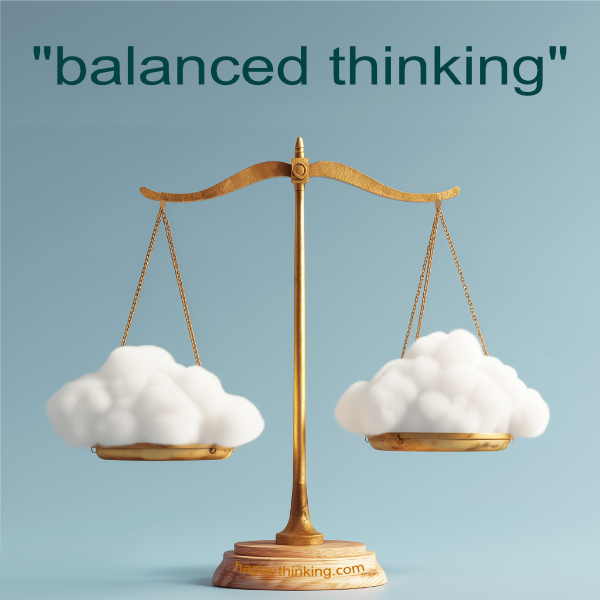
On this page, I will explain a type of negative thinking called “all-or-nothing thinking.” With this way of thinking, one sees everything as either being extremely positive or extremely negative, rather than in a more realistic way, between the two extremes.
Most things in the world around oneself are not “extreme”. There is a good chance that the coffee or tea one drinks at the train station every day doesn’t taste “extremely good” or “extremely bad”. Instead, it is more likely to taste between the two extremes. Similarly, one’s colleagues at one’s workplace are probably not “extremely friendly” or “extremely unfriendly”, but more likely to be somewhere in between.
When one thinks only in extremes (e.g., that coffee is extremely good, my colleagues are extremely bad, etc.) rather than seeing things in a more realistic “in-between way”, psychologists call this thinking “all or nothing thinking”. The word “all” represents one extreme, and the word “nothing” represents the other.
Psychologists also call this kind of thinking “black and white thinking”, which similarly portrays extremes, rather than more realistic in-between thinking.

All-or-nothing thinking can make one unhappy, as it can make one judge situations wrongly. The following short example will help one understand how it can cause harm.
Imagine that you have a good friend called Lucy. She has been your faithful friend for many years, sharing your happiness and troubles. Lucy has always gone out of her way to help you whenever you were in need.
Let us now imagine that today is your birthday and that Lucy, perhaps because she was busy, forgot to wish you. Let us suppose that your mind does all-or-nothing thinking. Your mind will think, “Lucy is a terrible person who does not care about me. How could she forget my birthday, when she knows I like people to wish me? She is completely useless, etc.” In this scenario, “all-or-nothing thinking” makes you think only in extremes. You ignore all the good that Lucy has done over the years and let this one small error she made make her “all bad”.
In reality, while it was “bad” for Lucy to have forgotten your birthday, it was only one “bad” thing among the many more “good” things she has done for you over the years. So instead of seeing Lucy as “completely bad”, a better way would be to see her as being “mostly good” and only “slightly bad”. As you have seen in this example, all-or-nothing thinking can make one judge people unfairly.
As seen in the example above, all-or-nothing thinking distorts the reality of the situation, which can lead to incorrect judgments. It is, therefore, essential to learn to think in a balanced way, where one puts into perspective both the positive and negative aspects of everything, rather than seeing things only in extremes.